
Guides
Picanha Cut: What It Is, How to Cut It & How to Grill It
Picanha: The Cut That Conquered the Grill
I’m speaking from memory of thousands of nights in front of the fire. There are good cuts, and then there are cuts that change everything. Picanha—picaña in Spanish—is one of those. That triangle of red meat crowned by a generous fat cap, like a hat that protects and bastes the meat as it cooks. It’s the undisputed queen of Brazilian churrasco, but it’s also earned an altar on grills across Latin America, and for good reason: it has intense flavor, a melt-in-your-mouth texture, and a juiciness that needs no marinade or tricks.
When it hits the grill, the fat slowly renders, caresses the meat, and makes it almost buttery. It’s not a lean cut; it’s a cut with personality. And if you learn to treat it right, it rewards you with an experience few cuts can match. This is the deep dive on the cut itself; if you want the full picture, it’s in my guide to beef cuts. Here, I’m going to tell you everything you need to know to make picanha the star of your next barbecue.
What Is Picanha and Where Exactly Does It Come From?
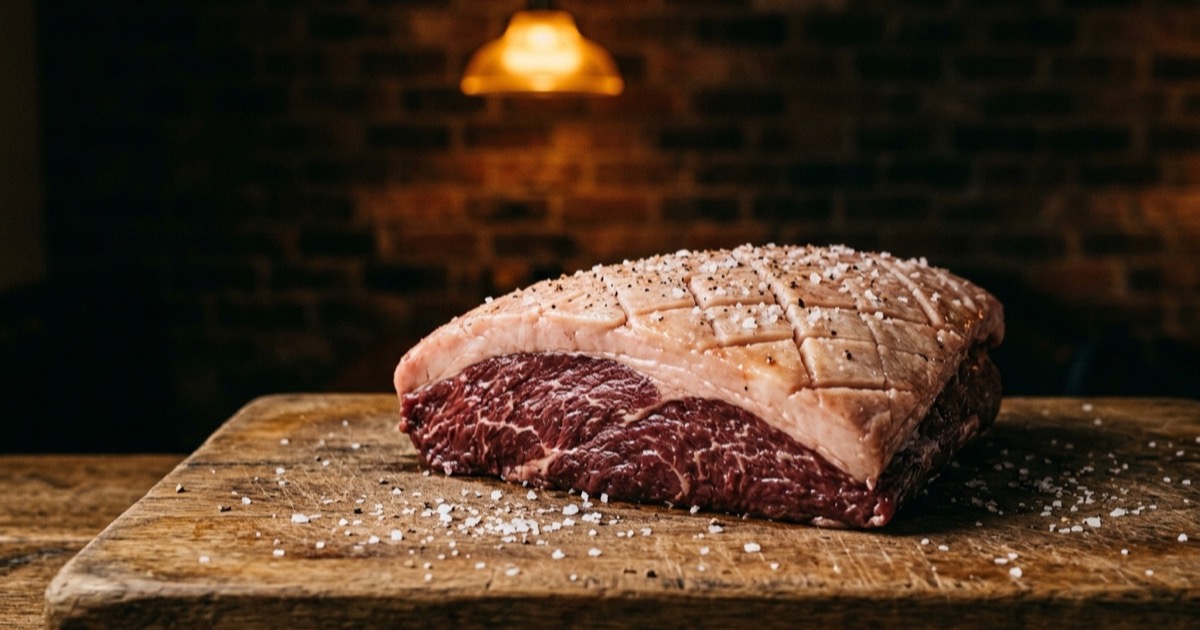
Let’s get into the anatomy, no beating around the bush. Picanha is a cut that comes from the top of the hindquarter, specifically the gluteus maximus muscle, located over the hip. In US nomenclature, it’s called the sirloin cap or top sirloin cap, but here we know it by its Portuguese name: picanha. It has a very distinctive triangular shape: one side is a flat face covered by a fat cap about one to two centimeters thick, while the rest of the muscle is lean and firm.
It’s important not to confuse it with the chuck flap, which comes from a different area. Picanha has its well-defined fat cap, and its weight usually ranges between 1 and 1.5 kg. If you see a larger piece (2 kg or more), it likely includes part of the adjacent muscle, and the texture won’t be the same. Authentic picanha has a fine grain and white, firm, clean fat.
How to Choose and Buy Good Picanha
When buying, you need to keep your eye sharp. First, the fat cap must be intact, not trimmed off. It should be white or slightly cream-colored, never yellowish (yellow indicates the fat has oxidized or the animal was no longer young). Second, look for a bright red color in the meat, not dark or dull. Third, the ideal weight is between 1 and 1.5 kg; smaller pieces may be from very young animals, and larger ones often include another muscle.
When you ask your butcher, be clear: “I want a whole picanha, with its fat cap, not trimmed.” Many butchers sell it without the fat because they think the customer doesn’t want it, but that’s a mistake. The secret of picanha is in that fat. Also, check that it has some marbling within the muscle, not just the outer cap. A good picanha has fine streaks of intramuscular fat that make it more flavorful.
How to Cut Picanha
Here’s the crucial point that separates an experienced cook from someone who wastes the cut. Picanha has long fibers that run lengthwise along the piece, from the wide base to the narrower tip. If you cut the whole piece with the grain (i.e., slicing parallel to the fibers), it will be tough as a shoe sole, even if you cook it perfectly.
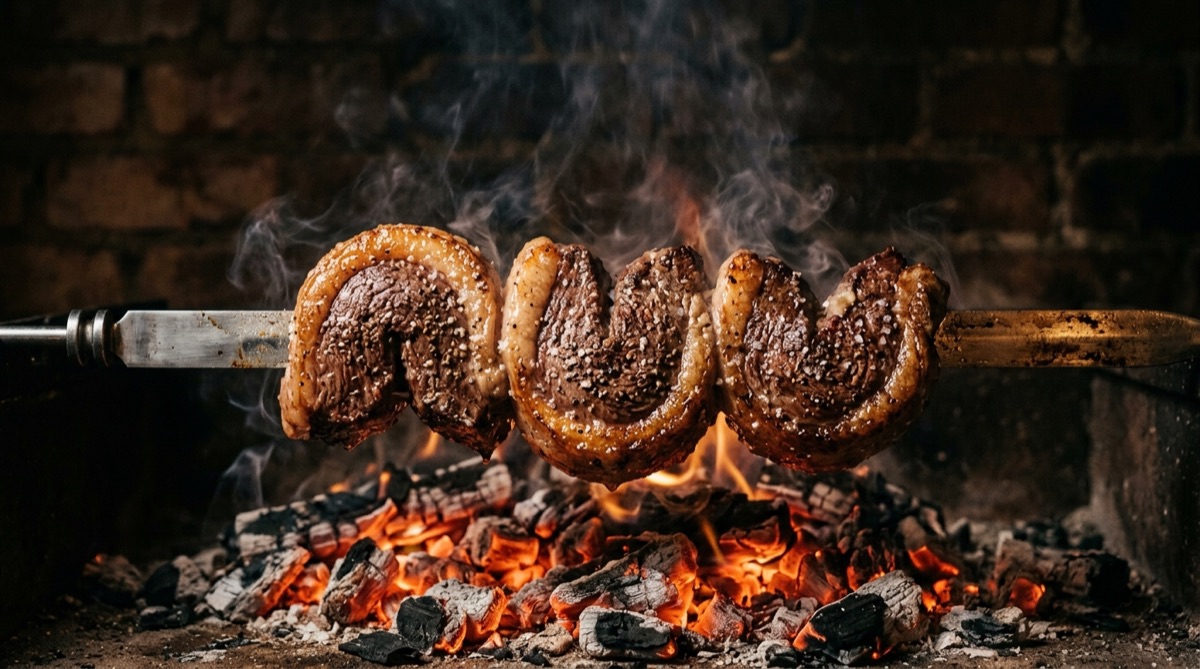
For Brazilian-style churrasco—those “C”-shaped steaks skewered on a sword—here’s what to do: place the piece on the cutting board with the fat cap facing down. Identify the direction of the fibers (they’re clearly visible as longitudinal lines). Cut against the grain, meaning perpendicular to those lines, into thick pieces 3 to 4 cm wide. Each piece will have a portion of the fat cap at one end. Then, to skewer, fold each piece into a “C” shape with the fat facing outward, so it’s exposed to the fire.
If you prefer to cook it whole (reverse sear or smoked method), don’t cut it until after cooking. In that case, roast the whole piece, let it rest, and then slice it thin, always against the grain, like a roast beef. An extra tip: before cooking, score the fat cap in a diamond pattern (without cutting into the meat) so the fat renders more easily and the piece cooks evenly.
How to Cook Picanha on the Grill (3 Methods)
1. Churrasco on a Skewer
Cut the steaks into “C” shapes as I explained. Skewer them on a metal skewer or sword, with the fat facing the fire first. Coarse salt to taste (about 3-4 grams per kilo). Cook over high heat (hot coals) for about 3-4 minutes per side, turning so the fat browns and the meat stays pink inside. Ideal doneness: medium (130-135°F / 54-57°C). Don’t pierce the meat with a fork; use tongs.
2. Whole Piece Over Indirect Heat (Reverse Sear)
Season the whole piece with coarse salt. Place it on the grill with the fat cap facing up, away from direct coals (indirect heat, grill temperature around 250-300°F / 120-150°C). Cook slowly until the center reaches about 120°F / 50°C (about 25-30 minutes for a 1.2 kg piece). Then sear over direct heat on both sides, 2 minutes each, and let rest for 5-7 minutes before slicing against the grain. The fat renders slowly, and the meat ends up evenly pink.
3. Slices on a Griddle
If you don’t have a grill, cut the picanha into 1.5 cm slices (always against the grain) and cook them on a hot griddle with a little oil, 2-3 minutes per side. The result will be faster but just as juicy if you respect the doneness.
Regardless of the method, the ideal doneness is pink, medium (130-135°F / 54-57°C). Overcooking makes it dry, and that’s a sin. And always, always let it rest covered with aluminum foil for about 5 minutes before cutting so the juices redistribute.
Common Mistakes with Picanha
- Trimming the fat: Removing the fat cap before cooking is the most serious mistake. That fat is what keeps it juicy and gives it flavor. If you remove it, you’ll have a lean, dry piece of meat.
- Cutting with the grain: I already said it, but I’ll repeat it: picanha is cut against the grain. If you cut it with the grain, you’ll get tough, fibrous, unpleasant meat.
- Overcooking it: Picanha handles medium doneness well, but beyond that, it becomes chewy. Don’t take it to well done unless it’s a very thin piece.
- Not using coarse salt: Fine salt melts and doesn’t form that necessary crust. Coarse salt, generous, just before putting it on the fire. Don’t salt too far in advance because it draws out juices.
- Not letting it rest: Cutting it right off the grill causes the juices to spill out. Always rest it.
What to Serve with Picanha
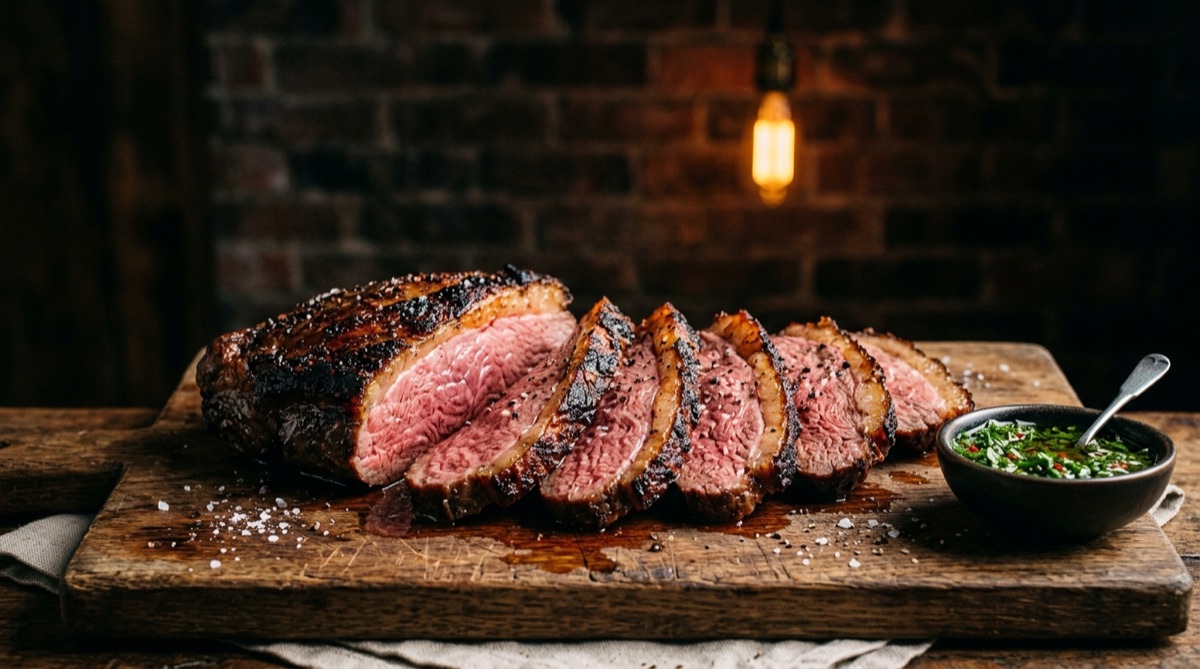
Picanha is so flavorful that it doesn’t need big fanfare. A good chimichurri (parsley, garlic, vinegar, oil, oregano) or a Dominican criolla sauce (red onion, peppers, lime, cilantro) goes wonderfully with it. It’s also perfect with Brazilian farofa (toasted cassava flour with butter and onion), fried yuca, or a plate of sautéed potatoes. A fresh green salad with a citrus vinaigrette helps cleanse the palate. And if the grilling bug bites you, take a look at my Argentinian-style grilled burgers.
For drinks, a medium-bodied red wine like an Argentine Malbec or a Chilean Cabernet Sauvignon are classic companions. If you prefer beer, a well-chilled lager or a balanced IPA works. In the Dominican Republic, an aged rum with a touch of ice is also a never-fail option.
At Valerio Burger Club
At Valerio Burger Club, in El Millón, Santo Domingo, picanha holds a special place on our menu. We serve the Picanha and Frites: 8 ounces of picanha grilled, accompanied by golden fries. It’s a dish that customers who know their cuts ask for again and again. If you come to the restaurant or order delivery, try it. I assure you, you’ll understand why I say picanha is the queen of the grill.
Frequently Asked Questions About Picanha
What is picanha?
Picanha is a beef cut from the top of the hindquarter, specifically the gluteus maximus muscle. It’s characterized by its triangular shape and a thick fat cap that protects it and adds juiciness when cooked.
Where does picanha come from?
It comes from the sirloin cap or top sirloin cap, located over the animal’s hip. It’s the gluteus maximus muscle found in the upper rear, just before the tail. It should not be confused with the flank or chuck flap.
How to cut picanha?
The key is to cut against the grain. If you’re making churrasco, cut the piece into thick steaks (3-4 cm) perpendicular to the direction of the fibers, forming pieces with the fat at one end. If you roast it whole, slice it thin when serving, also against the grain.
What temperature is best for picanha?
The ideal doneness is medium, with an internal temperature of 130-135°F / 54-57°C. This way it’s pink, juicy, and tender. If you cook it more, it dries out and loses its characteristic texture. Use a kitchen thermometer to avoid mistakes.
Should you remove the fat from picanha?
No, the fat is a fundamental part of the cut. During cooking, the fat renders and bastes the meat, adding flavor and keeping it moist. It’s only trimmed if it’s too thick or if you want to reduce fat content, but then it loses its essence.
From the blog to your table
In Santo Domingo? Don't read on an empty stomach.
Order your favorite burger from Valerio Burger Club and we’ll deliver it to your door. Beef ground daily, artisan buns and house-smoked meats.
Keep reading
 Guides
 How to Spell Hamburger (and the Misspellings to Avoid)
The correct spelling is 'hamburger' — H-A-M-B-U-R-G-E-R. Here are the most common misspellings, why it ends in -er, and where the word comes from.
 Guides
 Historic Places in the Dominican Republic: The Essential Guide
A guide to the historic places of the Dominican Republic: the Colonial City of Santo Domingo (a UNESCO World Heritage Site), the first cathedral in the Americas, Fortaleza Ozama and more.
 Guides
 What Is the Biggest Airport in the Dominican Republic?
The biggest airport in the Dominican Republic by traffic is Punta Cana (PUJ), with ~11 million passengers in 2025. Here's a clear guide to the country's airports.