
Guides
Hot Dog History: Why Is It Called That?
Hot Dog, Perro Caliente, Perrito Caliente: Same Dish, Different Name, and a Story That Starts with a Dachshund
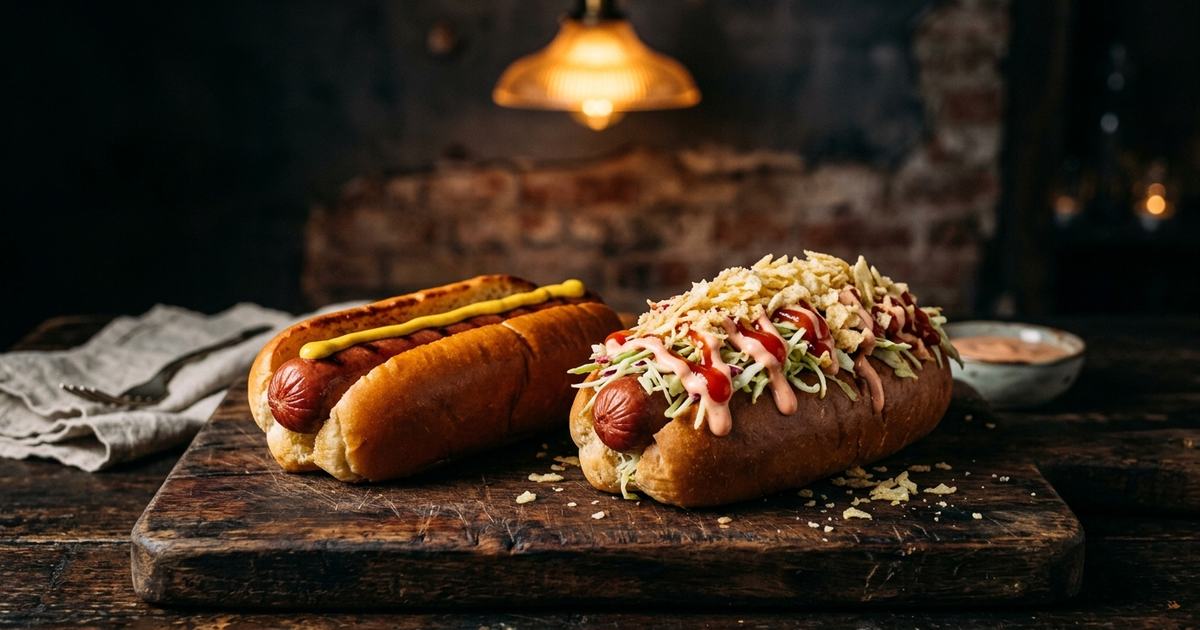
If there’s one thing I love about street food, it’s how the same bite travels the world and transforms without losing its essence. The hot dog—or perro caliente, or perrito caliente—is the perfect example: a cooked or grilled sausage inside a long bun. Sounds simple, but behind it lies a century and a half of migrations, popular ingenuity, and a name born from a college joke. In this article, I’m going to tell you the real story (and the legend) of this classic, why it’s called that, and what they call it in every corner of Latin America and Spain.
From Frankfurt and Vienna to Coney Island: The History

The sausage we now stuff into a bun has two birthplaces that both claim the invention: Frankfurt, Germany, with its frankfurter, and Vienna, Austria, with its wiener. Both cities have documents and local pride. What’s certain is that German immigrants brought these sausages to the United States during the 19th century, and that’s where it all began.
The first reliable record of a sausage served in a bun dates from between 1867 and 1871, when a baker and street vendor named Charles Feltman started selling them in Coney Island, New York. His cart was a hit. Years later, a former employee of his, Nathan Handwerker, opened his own stand in 1916: Nathan’s Famous, which remains an icon to this day. And it was Harry M. Stevens, a food vendor at baseball stadiums, who popularized the format during games, making the hot dog the indispensable companion of nine innings.
Thus, what began as immigrant food became a symbol of American popular culture and, later, of the world.
Why Is It Called “Hot Dog”? The Legend and the Truth
Here comes the juicy part. We’ve all heard the story that the name was born from a 1901 cartoon in which the illustrator Tad Dorgan depicted a dachshund inside a bun and, not knowing how to spell “dachshund,” wrote “hot dog.” Sounds great, right? Well, food historians have never found that cartoon. There’s no trace of it in newspaper archives from that era. It’s a charming urban legend, but without proof.
The real explanation, though less cinematic, is just as curious. In the late 19th century on US college campuses, these sausages were already being called “dachshund sausages” because of their elongated shape. Additionally, jokes circulated about the sausages’ contents—people said they contained dog meat—and the word dog was used in slang to refer to low-quality or questionable things. So the term “hot dog” appeared in the 1890s as a mix of humor, nickname, and college mischief. The earliest surviving printed mention is from 1895, in a Yale university newspaper. There’s no single inventor, but a collective process of popular baptism.
Hot Dog, Perro Caliente, or Perrito Caliente?
In Spanish, these names are literal calques from English. Hot dog was directly translated as perro caliente and, in its diminutive form, perrito caliente. The difference is geographic:
- Spain uses almost exclusively perrito caliente.
- Much of Latin America (Mexico, Colombia, Venezuela, Peru, etc.) says perro caliente.
- Dominican Republic and many other Caribbean countries prefer the Anglicism hot dog as is.
But I insist: it’s the same dish. There is no official recipe that distinguishes a hot dog from a perro caliente. The difference, as we’ll see later, lies in the style of preparation.
The Same Dog with Many Collars: Names by Country
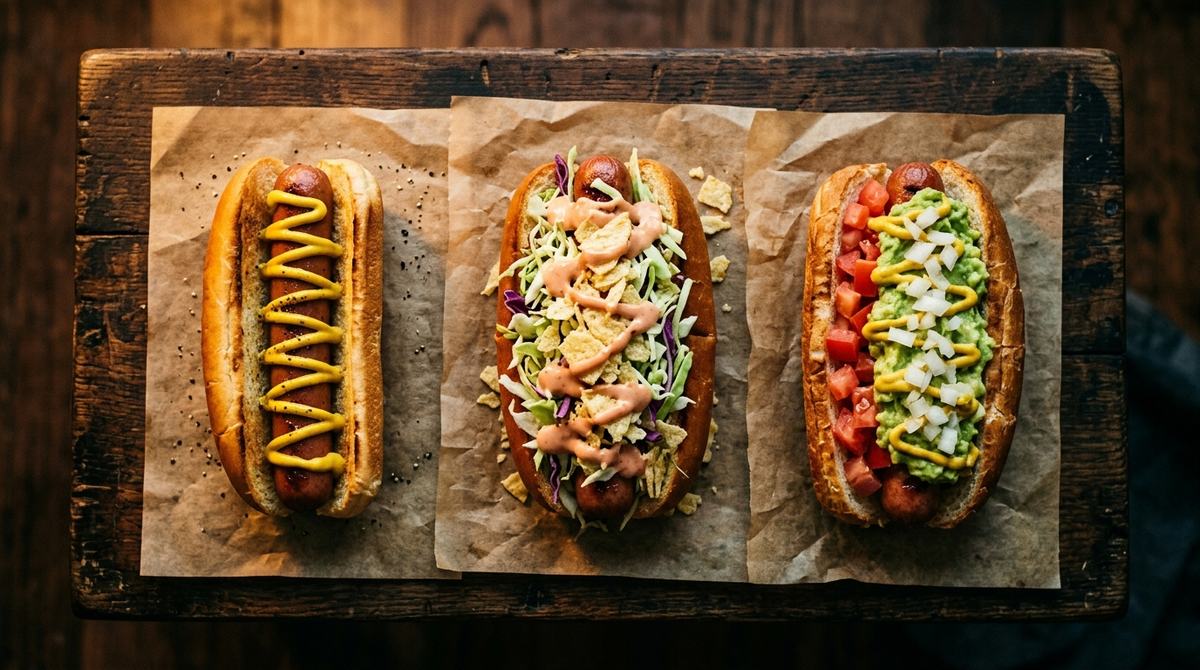
Here’s a table with the most common names and their local twist:
| Country | Name | Local Touch |
|---|---|---|
| Argentina / Uruguay | Pancho | Served with mayonnaise, mustard, ketchup, and sometimes crushed potato chips on top. |
| Mexico | Jocho or dogo | Topped with avocado, cream, shredded cheese, and pickled chili peppers. |
| Chile | Completo | Includes avocado (palta), tomato, sauerkraut, mayonnaise, and sometimes chili. It’s a national monument. |
| Guatemala | Shuco | Toasted bun, grilled sausage, guacamole, pickled cabbage, and tomato sauce. |
| Colombia / Venezuela | Perro (colloquial) | Loaded with shredded cabbage, crushed potato chips, sauces (pineapple, tartar, pink), yellow cheese, and sometimes egg. |
| Spain | Perrito caliente | Served on a Vienna roll with classic toppings: mustard, ketchup, fried onion. |
| Dominican Republic | Hot dog | Sold at street stalls with cabbage, onion, sauces, and potato sticks. |
Is There a Difference Between a Hot Dog and a Perro Caliente?
If we’re being strict, there is no conceptual difference: both are sausage in a bun. But in practice, the style draws a line:
- The classic American hot dog tends to be more minimalist: beef or pork sausage, soft bun, yellow mustard, pickle relish, chopped onion, and sometimes sauerkraut. Period.
- The Latin American perro caliente is a festival of toppings: shredded cabbage, crushed potato chips, melted cheese, multiple sauces (pineapple, tartar, pink, garlic), avocado, egg, etc. It’s more hearty and street-style.
In my experience, the Venezuelan perro caliente—with its layers of cabbage, potato sticks, and sauces—is one of the most complex and delicious in the world. And I’m telling you this as someone who grew up seeing hot dog carts on the corners of Caracas.
In the Dominican Republic, this loaded style has its own name: I tell you all about it (with a recipe) in Dominican hot dog. And if you want the sauce that crowns Venezuelan perros calientes, here’s my Venezuelan tartar sauce for hot dogs.
At Valerio Burger Club
At Valerio Burger Club we don’t sell hot dogs. Our thing is gourmet burgers, made with fresh Angus beef, artisan buns, and our own sauces. But I’d be a lying chef if I didn’t acknowledge that street food culture shaped us. The hot dog carts in Venezuela, the hot dog stands in New York, the completos in Chile… all of that is in my flavor memory. We have enormous respect for them.
If you’re in Santo Domingo and feel like a different experience, come visit us in El Millón. Or order delivery. We’ll be waiting for you with a burger that also has its own story.
Frequently Asked Questions
Why is a hot dog called that?
The name emerged in the 1890s at US universities as a joke. Sausages were called dachshund sausages (for their resemblance to dachshunds) and it was hinted that they contained dog meat. From there it was shortened to hot dog. The famous Tad Dorgan cartoon has never been found; it’s a legend.
Who invented the hot dog?
There is no single inventor. The frankfurter or wiener sausage already existed in Europe. The credit for putting it inside a bun is given to Charles Feltman (Coney Island, ~1867–1871). His former employee Nathan Handwerker popularized the idea with Nathan’s Famous (1916). And Harry M. Stevens brought it to baseball stadiums.
What’s the difference between a hot dog and a perro caliente?
None at its core: they are the same dish. The difference is stylistic: the classic hot dog is simpler (mustard, relish, onion), while the Latin American perro caliente usually has many more toppings (cabbage, potato sticks, multiple sauces, cheese).
How do you say hot dog in other countries?
It depends on the country: pancho (Argentina/Uruguay), jocho or dogo (Mexico), completo (Chile), shuco (Guatemala), perro (Colombia/Venezuela colloquial), perrito caliente (Spain). In the Dominican Republic, hot dog is used.
Which came first: the hot dog or the hamburger?
Both are contemporaries. Both arrived with German immigrants to the United States in the 19th century. The modern hamburger became established around 1900 (with the split bun and ground meat). The hot dog was already being sold in Coney Island in the 1870s. They are siblings from the same migration.
From the blog to your table
In Santo Domingo? Don't read on an empty stomach.
Order your favorite burger from Valerio Burger Club and we’ll deliver it to your door. Beef ground daily, artisan buns and house-smoked meats.
Keep reading
 Guides
 How to Spell Hamburger (and the Misspellings to Avoid)
The correct spelling is 'hamburger' — H-A-M-B-U-R-G-E-R. Here are the most common misspellings, why it ends in -er, and where the word comes from.
 Guides
 Historic Places in the Dominican Republic: The Essential Guide
A guide to the historic places of the Dominican Republic: the Colonial City of Santo Domingo (a UNESCO World Heritage Site), the first cathedral in the Americas, Fortaleza Ozama and more.
 Guides
 What Is the Biggest Airport in the Dominican Republic?
The biggest airport in the Dominican Republic by traffic is Punta Cana (PUJ), with ~11 million passengers in 2025. Here's a clear guide to the country's airports.